Dr. Lee's facelift lifts and repositions the deeper facial tissues, often called a deep plane or SMAS approach, rather than simply tightening skin. The lift is powerful, but it travels along the cheeks, jawline, and neck rather than lifting upward to the forehead.
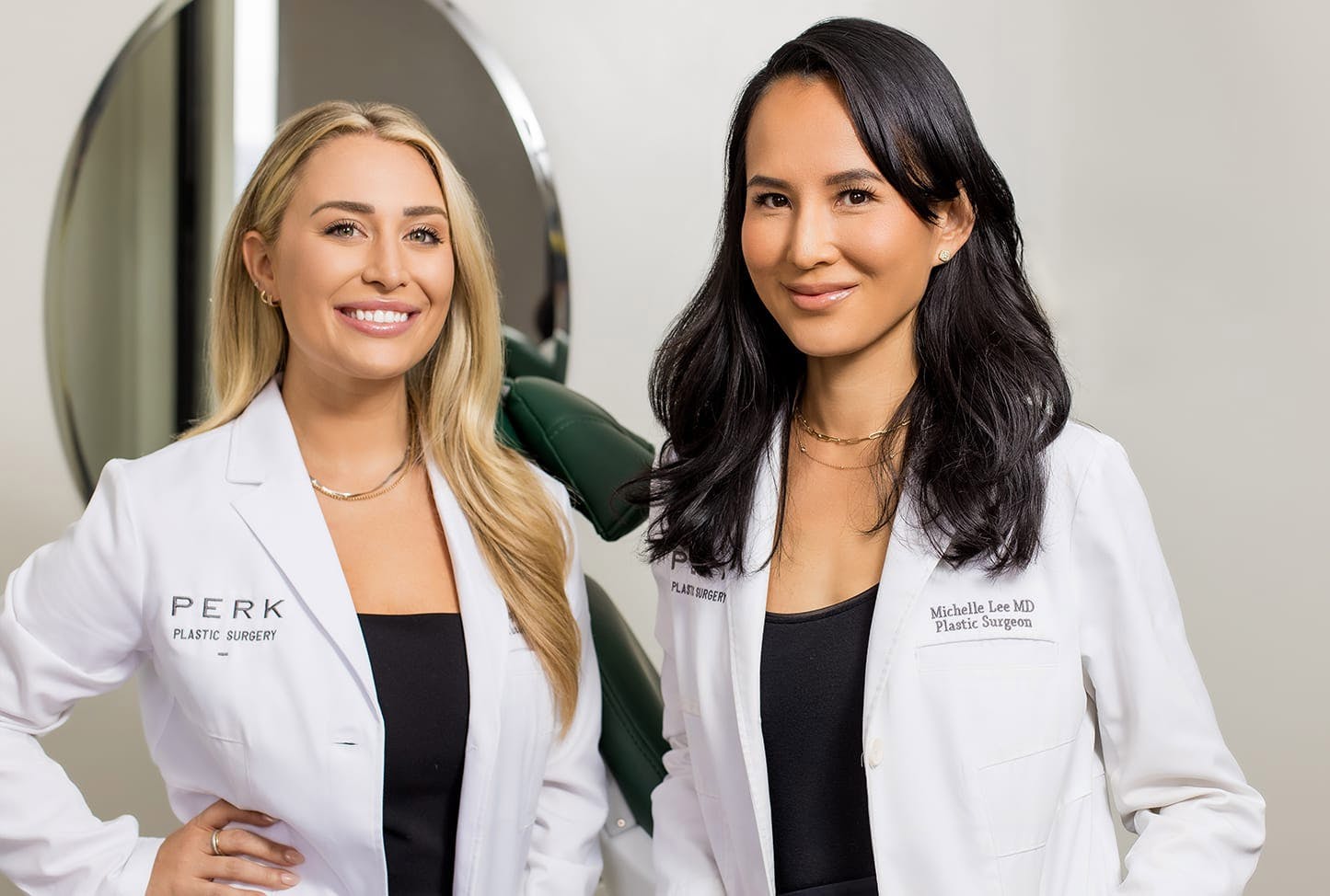
In this blog, Dr. Michelle Lee draws on her facial rejuvenation expertise to explain how the two procedures differ, why drooping brows can undercut an otherwise beautiful facelift, and how to tell whether you need one or both. Dr. Lee is a board-certified, Harvard-trained plastic surgeon who starred on E! Entertainment's Dr. 90210, where she was the only surgeon performing facial procedures.
Why Do Many Facelift Patients Need a Brow Lift Too?
Many facelift patients also need a brow lift because the two procedures treat different zones of the face.
A facelift addresses the lower two-thirds of the face and neck, while a brow lift raises the eyebrows by lifting the soft tissue and skin of the forehead. When the jawline is lifted and the brow stays low, the result can look uneven, with a refreshed lower face beneath a tired-looking upper face.
The AAFPRS notes that patients seeking more complete rejuvenation often combine a facelift with a brow lift, eyelid surgery, or other treatments, and that combining procedures may be more cost-effective.
Surgeons use several brow lift approaches, and the right one depends on hairline, brow shape, and goals:
- Endoscopic: Small incisions behind the hairline, with a tiny camera guiding the lift.
- Temporal: Lifts the outer brow through small incisions near the temples.
- Direct: Removes skin above the brow, often used for bushy brows.
- Coronal: Incisions across the top of the head.
- Hairline: An incision at the hairline, which can help patients with a high hairline.
Dr. Lee's surgical philosophy is the right procedure, for the right face, at the right time. She tailors her brow lift in Beverly Hills to each patient's anatomy, and for some patients that means a facelift alone.
For others, a brow lift restores balance between the upper and lower face so the outcome looks natural and harmonious rather than "pulled." A well-planned brow lift can also help achieve the popular "foxy eye" look, which many patients request.
Can Eyelid Surgery or Non-Surgical Treatments Replace a Brow Lift?
Eyelid surgery and non-surgical treatments can complement a brow lift, but they do not always replace it. Here is how each option fits:
- Eyelid surgery (blepharoplasty): removes excess skin and fat from the eyelids but does not reposition a brow that has descended. When a low brow is crowding the upper lid, treating only the eyelid may leave the underlying cause in place.
- BOTOX: part of PERK’s non-surgical menu and suited to milder cases.
- Sofwave Lift: FDA-cleared to lift the eyebrow in people aged 22 and older, and also suited to milder cases.
- Surgical brow lift: generally the better option for more pronounced brow descent.
Courtney Coons, FNP-BC, PERK’s board-certified nurse practitioner, specializes in nonsurgical facial rejuvenation. Non-surgical treatments require ongoing maintenance, so results are not as permanent as surgical outcomes.
Dr. Lee can assess which category applies to you during a consultation and often combines surgical and non-surgical care to achieve balanced results.
Who Is a Good Candidate for a Combined Facelift and Brow Lift?
A good candidate for a combined facelift and brow lift shows signs of aging in both the upper and lower face, has good overall health, and has realistic expectations. Common signs that the brow is part of the picture include:
- A brow that sits low or looks heavy over the eyes
- Upper eyelids that appear hooded or crowded
- Forehead creases or a tired, stern expression
- Jowls, sagging cheeks, or loose skin in the neck
Dr. Lee's candidacy guidelines for facelift surgery also include good emotional and physical health, being a non-smoker, having no major medical conditions, good skin elasticity, and realistic expectations. Mayo Clinic notes that smoking greatly raises the risk of poor wound healing after a facelift, and that blood-thinning medicines and supplements can raise the risk of hematoma.
Why Choose Dr. Michelle Lee for Facelift and Brow Lift in Beverly Hills?
Dr. Michelle Lee is a board-certified plastic surgeon who specializes in facial rejuvenation. She earned her medical degree from the University of Pennsylvania, completed a six-year plastic surgery residency at Case Western Reserve University under Dr. Bahman Guyuron, and finished a fellowship at Harvard Medical School's Beth Israel Deaconess Medical Center.
Dr. Lee has more than 20 peer-reviewed publications, serves on the editorial board of the Aesthetic Plastic Surgery Journal, and is recognized by Castle Connolly as a top plastic surgeon. In September 2025, she returned to Cleveland Clinic as Visiting Professor to deliver a lecture titled "Choosing the Right Facelift for the Right Face."
She makes incisions in the natural folds of the ear and the hairline, and she performs outpatient surgery at an accredited surgical center staffed by board-certified anesthesiologists. Her decade as a concert pianist shapes the artistry behind her natural, nuanced results.
To discuss a facelift and brow lift in Beverly Hills, schedule a consultation with Dr. Lee at PERK Plastic Surgery or call 310-881-8703.
Disclaimer: This blog is provided for educational purposes only and is not medical advice. It does not replace an evaluation by a board-certified plastic surgeon, and outcomes, risks, and suitability vary from patient to patient.
Sources